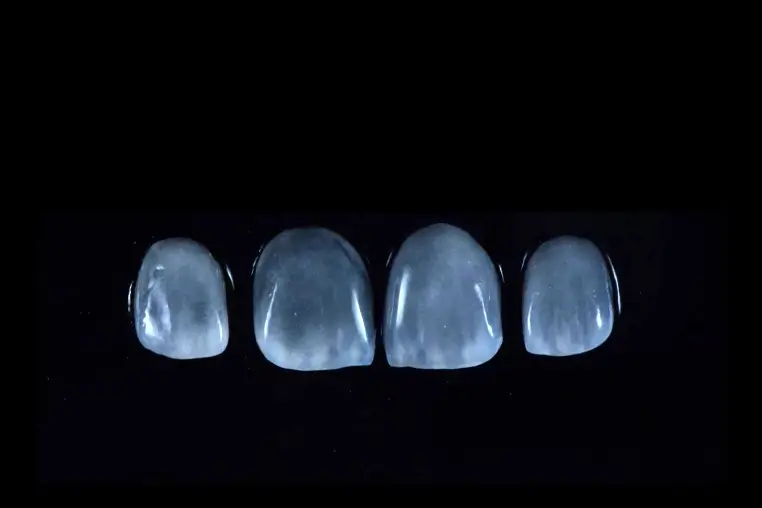
Refractory Die Technique and the Art of Porcelain Stratification
A Feldspathic Porcelain Veneer can reproduce subtle color transitions, internal detail, and incisal effects in carefully selected anterior cases. Its value comes from combining an appropriate ceramic with controlled fabrication, enamel-conscious preparation, and close communication between clinician and ceramist.
For private practice owners, prosthodontists, and cosmetic dentists, the practical question is how to translate an approved smile design into a restoration that integrates with the patient’s teeth and function. This guide explains the refractory workflow, porcelain layering, material selection, and records that support that process.
Joydenta Lab combines technician experience with digital case preparation to support individualized esthetic restorations for overseas practices.
I. What Is a Feldspathic Porcelain Veneer
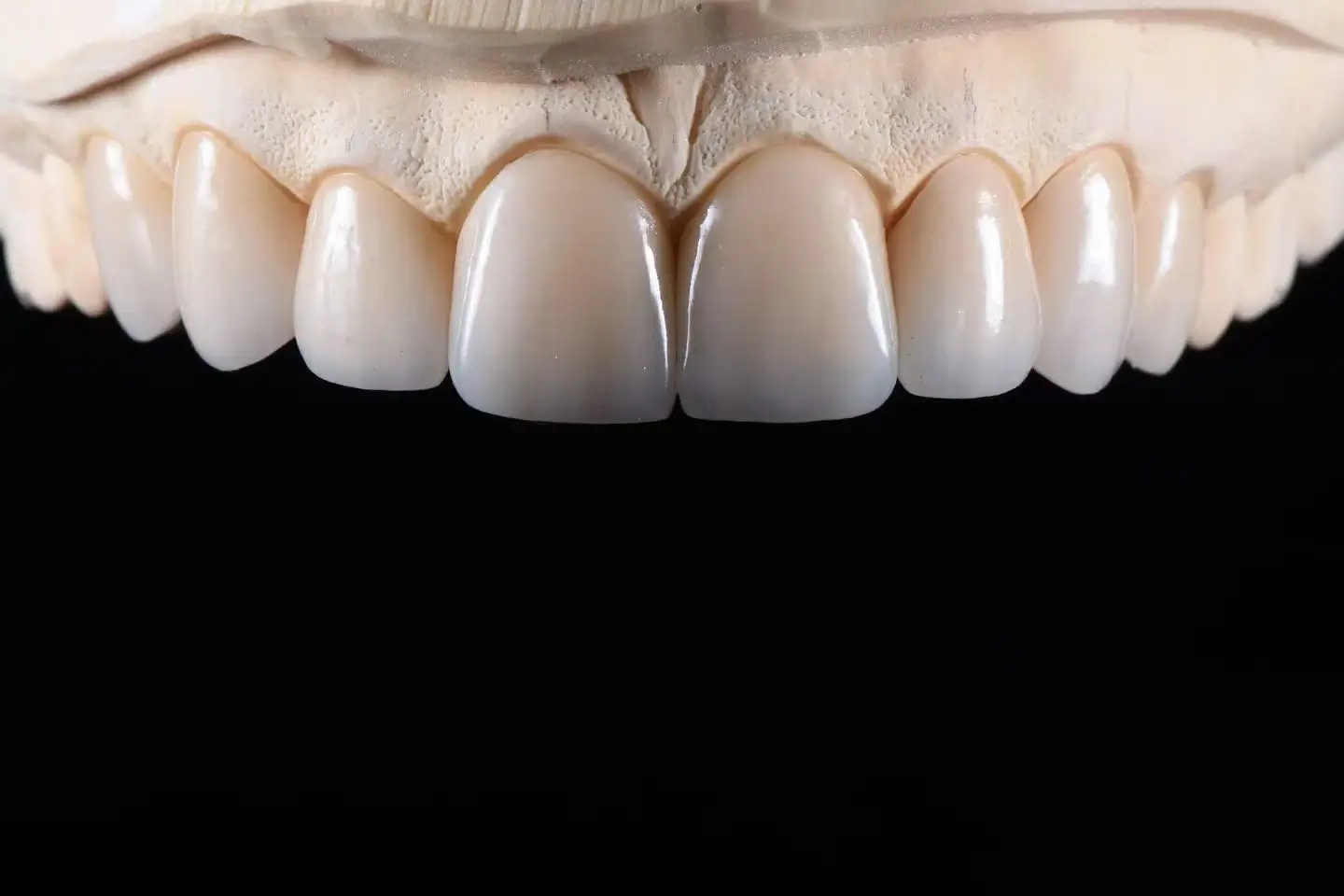
Feldspathic porcelain is a predominantly glassy dental ceramic used for esthetic restorations. In the hand-layered workflow discussed here, porcelain powders are mixed with liquid, built on a refractory die, and fired to form the veneer.
The material name does not identify one exclusive fabrication method. Feldspathic veneers may also be made using the platinum foil technique, and feldspathic ceramics are available for CAD/CAM processing. This article focuses on hand layering over refractory dies.
Where hand layering adds value
Porcelain stratification gives the ceramist control over the location of body color, translucent regions, and internal effects. These features can be developed within the available restorative space to match the intended tooth character.
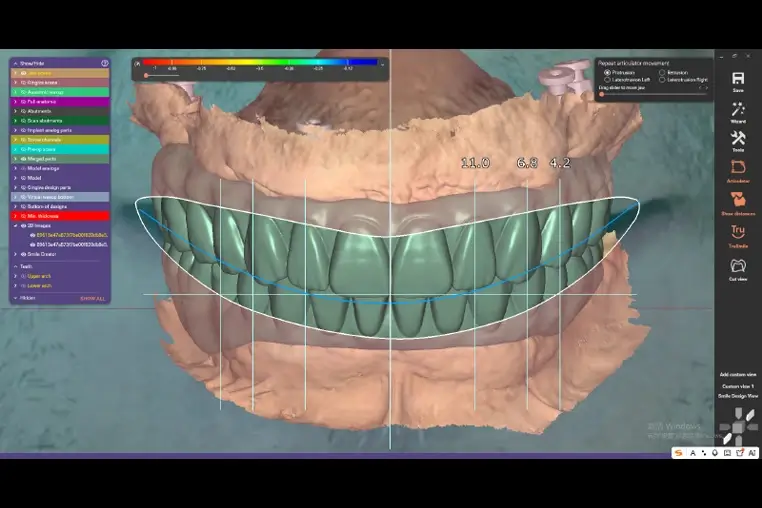
Digital and manual techniques can complement each other. Digital records and design help communicate contours, while ceramic layering individualizes the optical result. Pressed and milled restorations can also receive skilled characterization.
Case selection begins with enamel and function
Potential applications include selected changes in anterior tooth shape, small spaces, localized incisal defects, and color discrepancies that can be managed within the available thickness. Assess remaining enamel, preparation design, substrate color, existing restorations, periodontal health, and occlusion before prescribing.
Preserving enamel is a major planning priority. A retrospective study following porcelain laminate veneers for up to 12 years found higher failure risk with dentin bonding and preparation margins in dentin. This supports designing preparations around the proposed final contour and available enamel.
When to reconsider the restorative plan
Severe discoloration, extensive loss of tooth structure, large existing restorations, limited restorative space, or unfavorable loading may require another material, restoration design, or preliminary treatment. Active disease and parafunctional risk must be addressed clinically.
There is no universal minimum thickness or no-preparation prescription. A thin veneer is appropriate only when its contour, masking capacity, material requirements, and functional design suit the case. Laboratory and clinical planning should resolve these requirements before fabrication.
II. The Refractory Die Technique
Silicone duplication creates the firing support
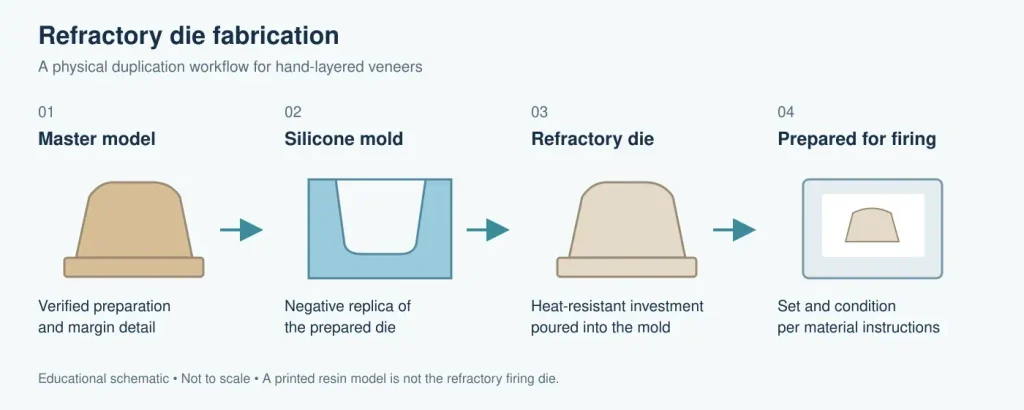
Refractory dies are duplicated from the working model or master dies using silicone and a compatible heat-resistant investment material. They are not directly 3D printed in the conventional workflow described here.
A published clinical–laboratory case documents silicone duplication of master dies followed by pouring and conditioning refractory duplicates.
Material handling determines the foundation
The silicone mold reproduces the preparation geometry. Refractory investment is mixed, poured, allowed to set, and removed from the mold. Drying and thermal conditioning then follow the selected material’s instructions.
The investment must support direct porcelain application and repeated firing with suitable dimensional behavior. Manufacturer documentation for phosphate-bonded refractory materials describes this use and application-specific expansion characteristics. Ordinary model stone and routine printed resin are not substitutes for the selected firing support. Choose a ceramic system indicated for the intended veneer technique, and follow its compatible investment and processing requirements.
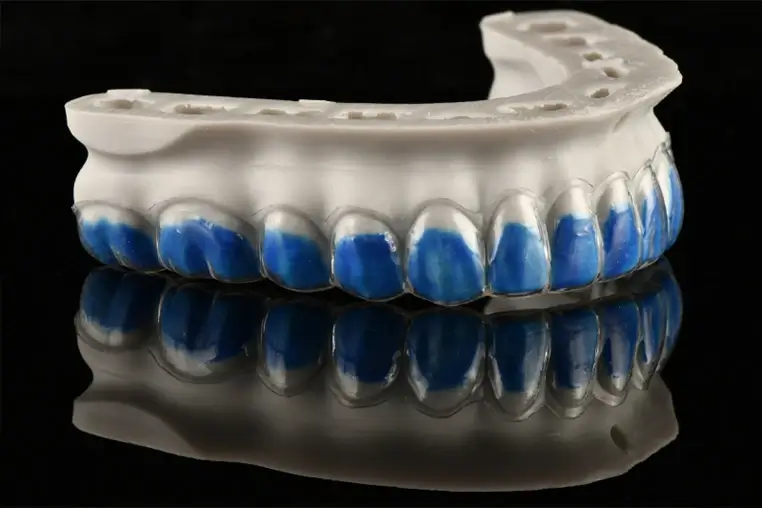
Distinguish a contour index from a duplication mold
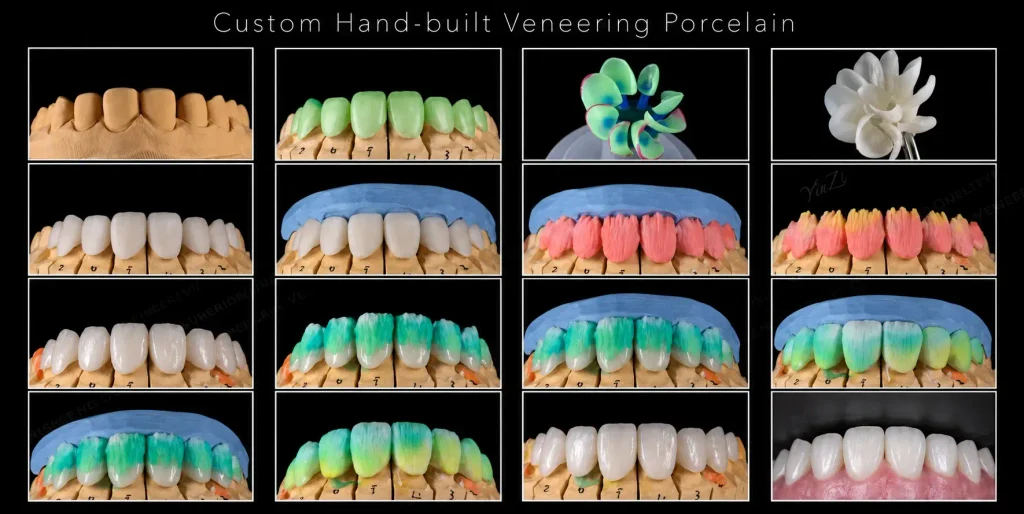
A silicone index used to check incisal length or external contours serves a different purpose from a mold used to duplicate the prepared die. The blue material visible in some reference images should not, by appearance alone, be labeled a refractory duplication mold.
III. Porcelain Stratification and Optical Character
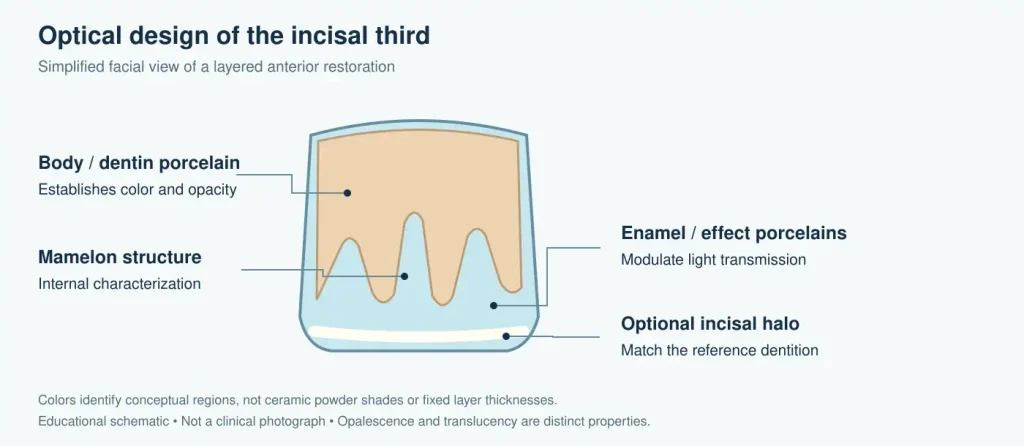
Porcelain Stratification is the controlled placement of ceramic masses with different optical properties. Body or dentin porcelains establish much of the color foundation; enamel and effect porcelains modify the appearance of the outer and incisal regions.
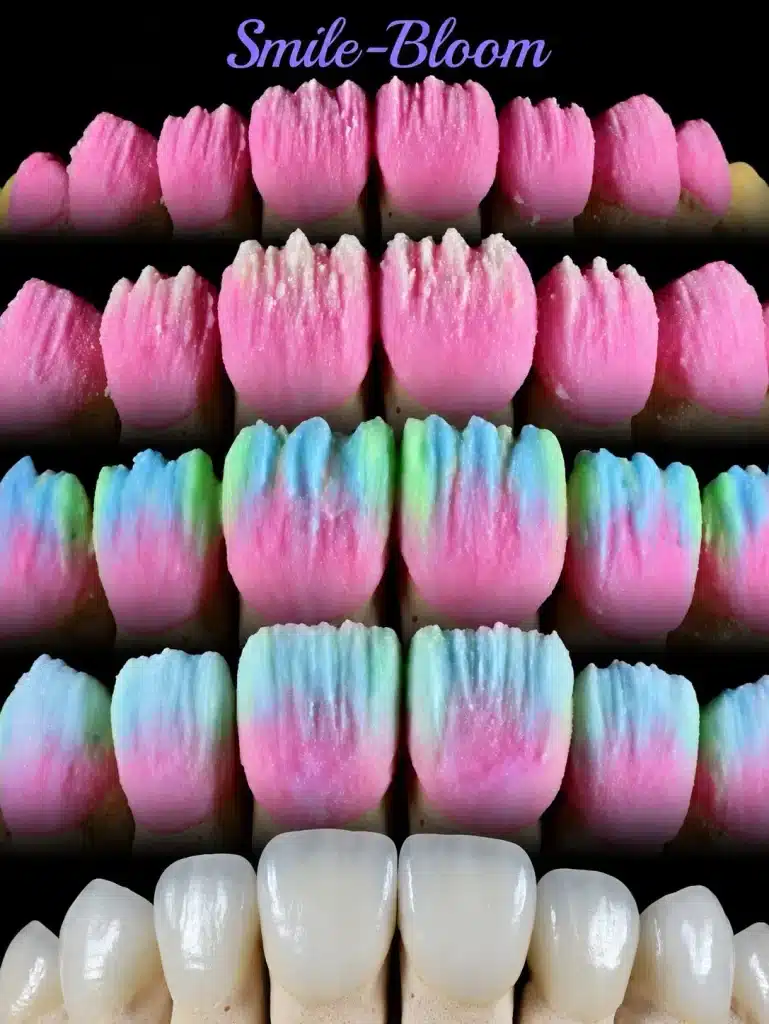
Published hand-layered workflows demonstrate the use of dentin, mamelon, translucent, and enamel ceramics to develop optical detail in limited space. The layer arrangement must follow the reference teeth and the selected ceramic system.
Mamelon Structure
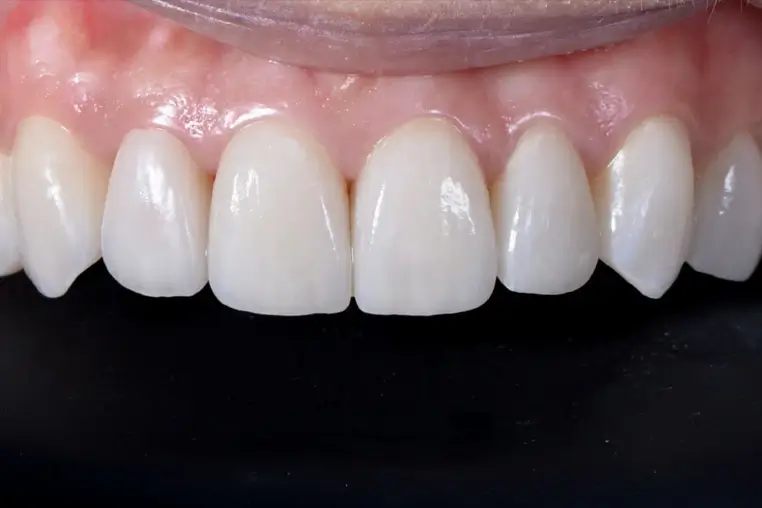
In ceramic characterization, Mamelon Structure refers to the internal incisal dentin pattern visible through overlying enamel. The ceramist can suggest these projections with body and effect porcelains. Their position and intensity should follow the reference dentition rather than a repeated pattern for every veneer.
Mamelon effects are not the same as adding prominent bumps to the finished edge. Manufacturers provide effect materials for internal characterization, but these should be used selectively to match the patient’s tooth character.
Incisal Translucency
Incisal Translucency describes light transmission through the incisal region. Opalescence is a distinct optical effect and is not interchangeable with transparency. Translucent, opalescent, and more opaque ceramic masses offer different tools for reproducing the reference tooth.
Firing and surface finishing
Controlled firings develop the ceramic structure and allow contour corrections. After the refractory material is removed using the appropriate method, the restoration is checked on the working model. Fine contouring, texture, and polishing complete the surface.
The prescription should describe the intended texture and gloss alongside shade and translucency. A close-up photograph with surface reflections can communicate these features more effectively than a shade designation alone.
IV. Feldspathic Porcelain Veneer vs Lithium Disilicate Veneer
Both materials can deliver highly esthetic anterior restorations. The comparison should focus on the clinical requirements and fabrication route rather than assuming that one material is always more natural or that digital production eliminates ceramic artistry.
| Consideration | Hand-layered feldspathic porcelain | Lithium disilicate |
|---|---|---|
| Fabrication | Powder layering and firing; refractory die workflow discussed here | Pressing or CAD/CAM processing, depending on the system |
| Optical customization | Local body, enamel, and internal effects built into the layering | Ingot or block selection, staining, and optional cut-back layering |
| Mechanical behavior | Thin unbonded veneers require careful handling and appropriate support | Generally higher material strength; design and bonding remain important |
| Translucency and masking | Controlled by layer composition, position, and thickness | Controlled by material opacity or translucency, thickness, and characterization |
| Preparation and thickness | Preserve enamel; provide space for shape, masking, and material requirements | Preserve enamel; follow product-specific design and thickness requirements |
| Clinical emphasis | Selected anterior cases requiring detailed individualized characterization | A range of veneer cases balancing esthetics and mechanical requirements |
| Production timing | Depends on case complexity, approvals, and firing requirements | Depends on production route, characterization, and approvals |
Lithium disilicate is available in different translucency and opacity options. Product selection and additional characterization can adapt its appearance to a range of restorative needs.
Material strength alone does not determine veneer longevity. Remaining tooth structure, bonding conditions, preparation design, and loading remain central to the decision. Avoid comparing strength figures from different tests as though they directly predict clinical survival.
For the prescribing clinician, the useful question is whether the chosen material can meet the esthetic and functional objectives within the actual space and substrate available.
V. Records and Verification for Clinical Integration
Send a complete esthetic prescription
A shade tab is a starting point. For a feldspathic porcelain veneer case, include:
- Preparation and opposing-arch records, plus the bite relationship.
- Full-face, smile, retracted, and close-up photographs.
- Shade references and photographs of the prepared tooth color.
- The approved wax-up, mock-up, or provisional contours.
- Desired incisal position, tooth proportions, texture, gloss, and translucency.
- Relevant details of existing restorations, exposed dentin, and functional concerns.
Specify which features are essential and where the ceramist may individualize the result. Record any change requested after the approved design.
Model review and clinical try-in
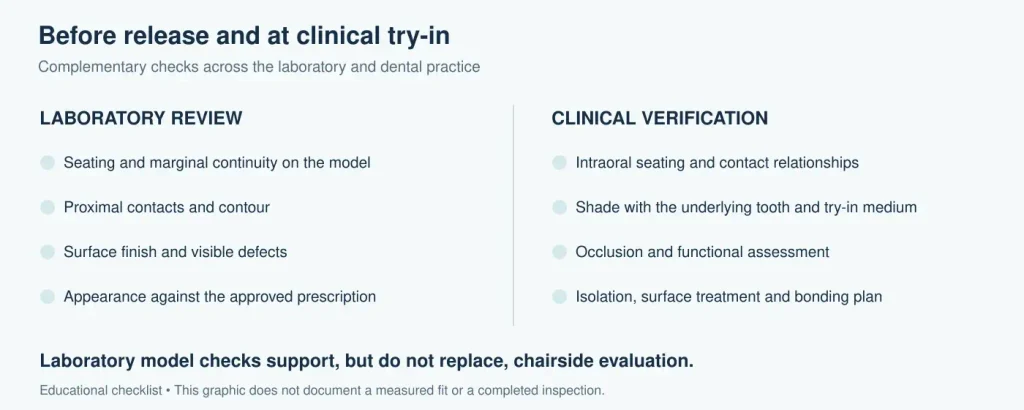
Laboratory checks assess seating, marginal continuity, proximal contacts, contour, and visible surface defects on the model. These checks support quality control but do not replace intraoral verification of fit, appearance, and function.
Confirm the surface treatment and bonding plan
Evaluate seating, contacts, contour, and appearance before definitive cementation. The underlying tooth and luting medium contribute to the appearance of a thin translucent veneer.
Coordinate ceramic conditioning and adhesive bonding with the laboratory. Follow the selected ceramic, primer, adhesive, and cement instructions, and confirm any treatment already completed by the laboratory. A documented hand-layered clinical workflow includes ceramic conditioning, silanization, and adhesive resin cementation.
VI. Partner with Joydenta Lab
Experience that supports case communication
Joydenta Lab was founded by dental technicians with more than 20 years of hands-on experience. We support overseas private practices, prosthodontists, and cosmetic dentists with individualized esthetic restorations and laboratory collaboration.
For feldspathic veneers, our case discussion begins with the preparation, substrate shade, approved contours, and intended optical character. Clear records help translate the clinician’s objectives into a practical ceramic prescription.
Case-specific lead times for feldspathic veneers
Hand-layered feldspathic veneers require a longer production schedule than many routine laboratory cases. Joydenta confirms the lead time individually after reviewing case complexity, the number of restorations, porcelain layering, and customization requirements, together with complete clinical records and any required approvals.
Confirm the production schedule and expected dispatch date before booking the patient’s seating visit. International transit and customs clearance require additional time; design changes or further characterization may also extend production.
DAP international delivery
Joydenta supports international delivery under DAP terms to the agreed destination. Under DAP, the seller arranges carriage and bears transport risk to the named place, with the shipment ready for unloading. The buyer handles import clearance, applicable import duties and taxes, and unloading.
Discuss your next veneer case with Joydenta Lab. Share your clinical photographs, preparation records, and treatment objectives to review material suitability, characterization, and the confirmed production schedule.
Technical references
- Gurel et al. Influence of enamel preservation on failure rates of porcelain laminate veneers. 2013.
- Patrick and Seay. A Case for Comprehensive Dentistry. 2013.
- GC. Investments technical information and refractory die materials.
- VITA. Clinical example of hand-layered veneers and optical characterization.
- SHOFU. VINTAGE porcelain instructions and effect materials.
- Ivoclar. IPS e.max CAD technical information.
- Williams. Porcelain veneer fabrication. Platinum foil and refractory model techniques. 1994.
- ICC Academy. DAP and DDP under Incoterms 2020.
- VITA. VITABLOCS Mark II feldspar blanks for CAD/CAM processing.
VII. Frequently Asked Questions
What is a Feldspathic Porcelain Veneer?
It is a thin restoration made from feldspathic ceramic. This article describes hand-layered veneers fabricated over refractory dies, although the material is not limited to that manufacturing route.
Is a refractory die directly 3D printed?
Not in the conventional technique described here. The working model or master die is duplicated with silicone, and heat-resistant refractory investment is poured into the mold. A printed working model may be used earlier in a digital workflow.
What do the pink and green buildup colors mean?
Colored stages in the reference montages document intermediate fabrication. They do not establish the final tooth shade or identify a specific ceramic system. Color alone cannot reliably distinguish the materials or visualization aids used; the documented case workflow is needed to identify each stage.
How thin can a feldspathic veneer be?
There is no universal thickness for every case. The planned shape change, substrate shade, available enamel, functional design, and chosen ceramic system determine the appropriate dimensions.
Is feldspathic porcelain always more esthetic than lithium disilicate?
No. Hand layering offers extensive customization, but lithium disilicate can also produce excellent esthetics. Material selection, characterization, preparation, and clinical integration all influence the result.
Does every veneer need strong mamelons and a visible incisal halo?
No. Characterization should match the reference teeth and the intended appearance. Strong internal effects can be inappropriate when a more restrained result is needed.
How long does Joydenta need to fabricate feldspathic veneers?
Hand-layered feldspathic veneers require more time than many routine laboratory cases. Lead times are confirmed individually after reviewing case complexity, the number of restorations, layering and customization requirements, complete records, and approvals. International transit and customs clearance are additional.
Are import duties included in DAP delivery?
No. Under DAP, the buyer is responsible for import clearance and applicable import duties and taxes. Confirm the named destination and shipment arrangements before dispatch.