
Chrome Cobalt Frameworks
Cobalt Chrome Frameworks for Removable Dentures
Cobalt chrome is not about metal strength alone.
At Joydentalab, it is about framework design logic, path of insertion control, and long-term clinical stability in removable prosthetics.
What Is a Cobalt Chrome Framework?
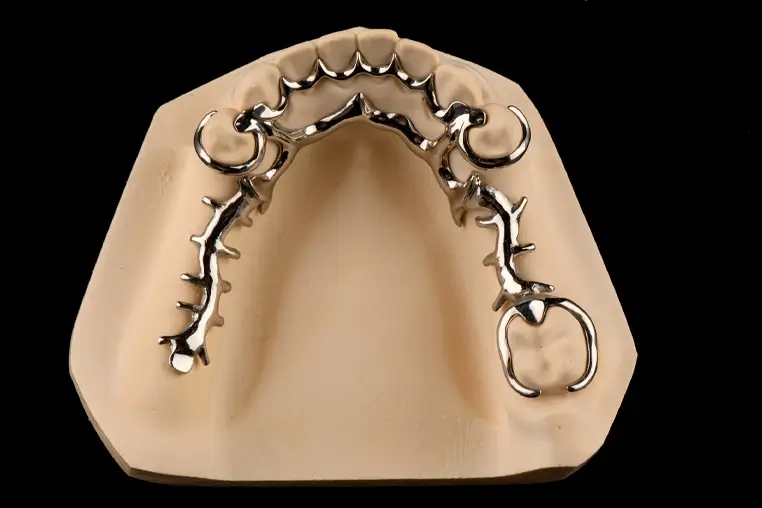
Cobalt Chrome (Co-Cr) alloy is a high-performance dental metal widely used for removable denture frameworks due to its strength, rigidity, corrosion resistance, and long clinical history.
In dentistry, cobalt chrome frameworks are most commonly applied in:
Implant-assisted removable prostheses
Metal substructures requiring long-term stability
From a clinical safety perspective, cobalt chrome alloys have been used in dentistry for decades.
When properly manufactured and polished, they demonstrate:
Excellent corrosion resistance in the oral environment
Stable mechanical properties under long-term functional loading
Biocompatibility suitable for intraoral use in removable restorations
At Joydentalab, cobalt chrome is selected specifically for cases where framework rigidity, clasp durability, and structural reliability are critical.
Which Patients Are Suitable for Cobalt Chrome Frameworks?
Cobalt chrome frameworks are typically recommended for patients who require functional stability and long-term durability rather than purely temporary solutions.
They are well suited for patients who:
- Present partial edentulism with remaining natural abutment teeth
- Require stable clasp retention over repeated insertion and removal
- Have sufficient oral hygiene compliance for removable prostheses
- Need a lightweight but rigid framework for comfort and function
Clinically, Co-Cr frameworks are often chosen when acrylic-only dentures lack sufficient strength or when flexible materials cannot provide predictable retention.
Cobalt Chrome vs Titanium Frameworks
| Aspect | Cobalt Chrome | Titanium |
|---|---|---|
| Mechanical Strength | High rigidity, excellent for long spans | Lower rigidity, more flexible |
| Framework Thickness | Thinner framework possible | Often requires thicker design |
| Long-Term Stability | Proven decades of clinical use | More technique-sensitive |
| Aesthetic Impact | Metal visible in clasps | Slightly lighter color |
| Manufacturing Cost | More cost-efficient | Higher material & processing cost |
| Practical Application | Widely used in RPD frameworks | Limited adoption for RPDs |
While titanium has advantages in implant dentistry, cobalt chrome remains the most practical and reliable choice for removable denture frameworks, especially when structural rigidity and cost control are required.
Alternative Framework Materials
Several materials can be used for removable denture frameworks, including:
However, cobalt chrome continues to be irreplaceable due to its unique balance of:
- High rigidity with reduced bulk
- Predictable casting behavior
- Cost-effective large-scale production
For laboratories and clinics managing consistent case volumes, cobalt chrome provides the most reliable balance between performance, cost, and manufacturability.
-
Case Evaluation
Review of impressions or STL files, design requirements, and clasp positioning.
-
Framework Design
Digital or manual design based on occlusal load and abutment conditions.
-
Wax Pattern / CAD Preparation
Framework structure finalized with controlled thickness.
-
Casting Process
Controlled Co-Cr casting to minimize shrinkage and deformation.
-
Finishing & Polishing
Surface smoothing to ensure comfort and hygiene.
-
Quality Check
Fit verification on master model before delivery.
Common Production Challenges & How We Solve Them
Framework Misfit
→ Controlled casting parameters and pre-delivery fit inspection.
Clasp Fatigue
→ Elasticity control through alloy selection and clasp design.
Excessive Bulk
→ Optimized framework thickness without compromising strength.
Surface Roughness
→ Multi-stage polishing and finishing process.
Client Feedback on Our Co-Cr Frameworks
Cobalt Chrome Framework – FAQs
Yes. Dental-grade cobalt chrome alloys used for removable frameworks are biocompatible and clinically approved for long-term intraoral use when manufactured under proper standards.
At Joydentalab, cobalt chrome frameworks are fabricated using:
Certified dental alloys
Controlled casting or SLM processes
Strict finishing and polishing protocols
This ensures the framework surface is stable, corrosion-resistant, and suitable for extended clinical service.
Both factors are critical, but framework accuracy is more sensitive to design and data interpretation than many clinicians realize.
Even with acceptable impressions or scans, poor relief control, clasp design, or connector thickness can result in misfit.
At Joydentalab, each cobalt chrome case undergoes pre-fabrication design validation to minimize these risks before production begins.
Minor adjustments are possible, but excessive chairside bending—especially of clasps—should be avoided.
Cobalt chrome is designed to be rigid. Improper adjustments may introduce micro-fractures that reduce long-term durability.
This is why accurate initial design and laboratory finishing are essential to limit the need for chairside corrections.
Quality consistency varies significantly and depends on:
Alloy selection
Casting or SLM control
Technician experience
Finishing standards
Two cobalt chrome frameworks may use the same material but perform very differently clinically.
Laboratory expertise and quality control are often more decisive than material choice alone.
Design modifications after fabrication are limited.
While minor repairs or laser welding may be possible in specific situations, major design changes typically require a remake.
This reinforces the importance of thorough communication and accurate prescriptions at the initial submission stage.
Long-term performance depends on:
Proper patient hygiene
Regular clinical follow-up
Avoidance of improper adjustments
From a laboratory perspective, a well-finished surface and accurate fit reduce plaque accumulation and improve clinical longevity.
