
All on 4 Solutions

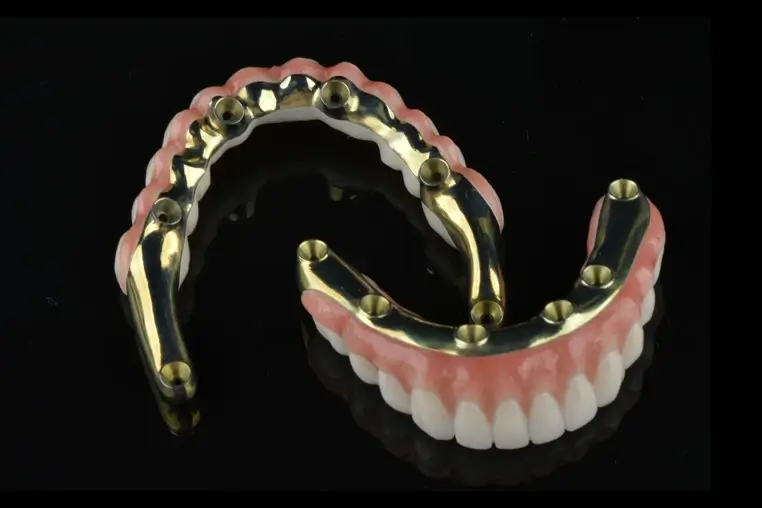
Full-Arch Implant Prosthetics Manufactured by Joydentalab

At Joydentalab, we manufacture All-on-4 full-arch prosthetic frameworks for dental laboratories and implant clinics worldwide.

All on 4 cases are never “standard” cases. Each arch presents different implant angulations, occlusal forces, and esthetic expectations. Our role is to translate surgical positioning into a mechanically stable, retrievable, and long-term reliable prosthesis.

Home / Implant Prosthetics / All on 4 Solutions

What All on 4 Means to Us as a Laboratory

Clinically, All on 4 refers to a full-arch prosthesis supported by four implants — typically two anterior vertical implants and two posterior angled implants.

From our laboratory perspective, All on 4 is primarily a biomechanical engineering case, not just a full-arch restoration.

The moment we receive an All on 4 case, we evaluate three critical factors:

Implant angulation and divergence

Cantilever length and load direction

Framework rigidity relative to arch span

In our experience, long-term success depends far more on passive fit and stress distribution than on esthetics alone.

Why All on 4 Requires Careful Laboratory Planning

Many clinicians choose All on 4 for surgical efficiency and immediate loading possibilities. However, what determines long-term performance is the prosthetic design stage.

Angled Posterior Implants

Posterior angulation helps avoid anatomical limitations.
But from our standpoint, angled implants introduce screw channel complexity and stress concentration at the interface.

We carefully adjust screw access positioning during digital planning to maintain retrievability without compromising structural integrity.

Cantilever Engineering

Cantilever Engineering

Cantilever segments are one of the most underestimated risk areas in All on 4 restorations.

When distal extensions exceed structural tolerance,

  • Screw loosening

  • Framework fatigue

  • Veneering fracture


We always evaluate cantilever length relative to arch size and occlusal scheme before finalizing framework design.

Immediate Loading Coordination

Immediate Loading Coordination

All on 4 often involves provisional restorations shortly after surgery.
This requires precise digital data transfer and rapid manufacturing turnaround.

Our workflow is structured to minimize remakes during this critical stage.

How We Execute All-on-4 Full-Arch Restorations

At JoyDentalab, every All-on-4 case follows a strictly controlled technical workflow to ensure accuracy, passive fit, and long-term stability.

8 (1)
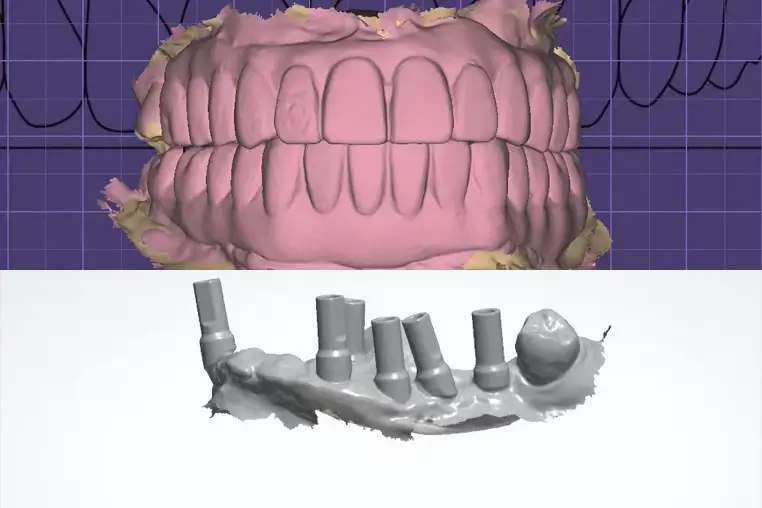
Step 1 – Occlusion & Scan Body Verification
Before design begins, we perform a comprehensive verification of all incoming data: 1️⃣ Occlusal relationship accuracy 2️⃣ Proper seating of scan bodies 3️⃣ Stability and completeness of digital impressions Improper scan body positioning or occlusal deviation at this stage can directly compromise final framework fit.
9 (1)
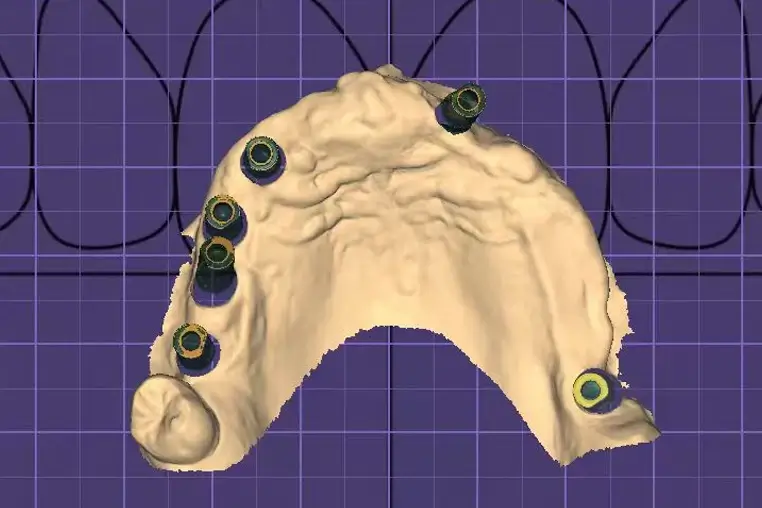
Step 2 – Scan Body Matching & System Identification
Each scan body is carefully matched to its corresponding implant system to ensure full compatibility. Our technicians verify: 1️⃣ Implant system and library alignment 2️⃣ Connection interface accuracy 3️⃣ Digital library matching precision Incorrect scan body matching may lead to interface misfit and mechanical complications.
10 (1)
Step 3 – Abutment Strategy & Restoration Planning
Due to the limited number of implants in All-on-4 cases, restoration design must prioritize load distribution and structural strength. We typically recommend: 1️⃣ Malo Bridge (Hybrid full-arch bridge) with individual crowns 2️⃣ Bar-retained overdenture combined with zirconia superstructure Custom abutments (multi-unit or composite base solutions) are planned to optimize angulation correction and prosthetic support.
3D Printed Models
Step 4 – Framework Design (Malo Bridge / Bar System)
The framework design is customized based on patient-specific anatomical parameters: 1️⃣ Arch curvature 2️⃣ Tooth width and proportion 3️⃣ Occlusal scheme 4️⃣ Functional load distribution Unlike conventional bridges, full-arch restorations require precise biomechanical planning to avoid stress concentration.
12 (1)
Step 5 – Material Selection (Titanium Framework)
For optimal strength and long-term stability, we standardize the framework material as: 1️⃣ Grade 5 Titanium (Ti-6Al-4V) for Malo bridges and bar systems Titanium offers: Excellent biocompatibility High strength-to-weight ratio Superior fatigue resistance for full-arch restorations
Titanium Plate
Step 6 – Precision Milling & Interface Control
All frameworks are milled according to the specific implant system interface requirements. Key controls include: 1️⃣ System-specific connection milling 2️⃣ High-precision tolerance management 3️⃣ Interface integrity verification Each framework undergoes strict quality inspection to ensure passive fit across all implants, which is critical for long-term success.

All-on-4 restorations are not standard prosthetics—they require a combination of accurate data verification, precise system matching, and biomechanically sound framework design.

At JoyDentalab, we focus on interface accuracy, structural strength, and passive fit control, ensuring every case meets the highest international laboratory standards.

Which Material Do We Recommend for All on 4?

We approach material selection case by case.

Titanium Framework

Titanium Framework

For high-load posterior arches or bruxism cases, titanium remains our most reliable structural material.

Its fatigue resistance and rigidity provide long-term mechanical stability.

Hybrid Solution (Titanium Base + Zirconia Superstructure)

Hybrid Solution (Titanium Base + Zirconia Superstructure)

In esthetic zones, hybrid frameworks allow strength with improved visual integration.

However, bonding control and structural design must be carefully managed.

Monolithic Zirconia

Monolithic Zirconia

For patients prioritizing metal-free solutions, zirconia may be indicated.

But in our experience, strict thickness control and occlusal planning are essential to reduce fracture risk.

Challenges We Frequently Observe in All on 4 Cases

Through years of manufacturing full-arch restorations, we commonly see:

  • Excessive distal cantilever

  • Implant divergence not fully corrected

  • Insufficient framework thickness

  • Occlusal overload concentrated in posterior segments

  • Inadequate retrievability planning

Most complications originate from mechanical stress accumulation rather than isolated errors.

Our role is to reduce these risks during design and manufacturing.

When Is All on 4 the Right Choice?

All on 4 is often selected when:

  • Full-arch edentulism is present

  • Bone volume limits posterior implant placement

  • Immediate loading is planned

  • A reduced implant count is clinically preferred

However, in high-load or extended arch cases, All on 6 may provide additional stability.

Case selection remains a clinical decision, but prosthetic feasibility must be evaluated simultaneously.

Our Perspective

At Joydentalab, we view All on 4 not as a standardized template, but as a structural engineering task.

Each case requires balance between surgical positioning, mechanical physics, and restorative design.

Precision manufacturing, passive fit control, and thoughtful material selection ultimately determine long-term success.

All on 4 – Professional FAQs

How do we evaluate an All on 4 case before production?

When we receive an All on 4 case, we first review implant system compatibility, implant angulation, vertical clearance, and arch span. Our primary concern is whether passive alignment across four implants can be achieved without internal stress. If implant divergence is excessive, we communicate adjustments before milling.

What is the most critical technical factor in All on 4 restorations?

In our experience, passive fit is the most critical factor. Even minor discrepancies across implant interfaces can create cumulative stress within the framework. Over time, this may contribute to screw loosening or structural fatigue. We prioritize interface precision before esthetic considerations.

How do we manage angled posterior implants?

Angled implants increase complexity in screw channel positioning. During CAD planning, we carefully control screw access emergence to preserve retrievability while maintaining structural thickness. Proper angulation correction is essential for long-term mechanical stability.

What is our approach to cantilever design?

Cantilever length is directly related to mechanical risk. We evaluate distal extension relative to arch size and expected occlusal load. When cantilever exceeds structural tolerance, we recommend reinforcement strategies or case reevaluation

Which material do we typically recommend for All on 4 frameworks?

For high-load arches, we generally prefer titanium due to its fatigue resistance and structural reliability. Hybrid solutions may be recommended for esthetic zones. Material selection is always case-dependent rather than standardized.

Can monolithic zirconia be used safely for All on 4?

Monolithic zirconia can be used, but only when thickness and occlusal design are carefully controlled. In long-span arches or bruxism cases, we remain cautious due to zirconia’s flexural limitations compared to titanium.

How do we verify passive fit before delivery?

After milling, each framework undergoes connection inspection and dimensional verification. We confirm alignment across all four implant interfaces to minimize internal strain before shipment.

What are the most common complications we see in All on 4 cases?

From a manufacturing standpoint, common risks include excessive cantilever, inadequate framework thickness, implant divergence, and uneven occlusal loading. Most long-term failures originate from stress concentration rather than isolated component defects.

Do we support immediate provisional All on 4 restorations?

Yes. We coordinate closely with laboratories when immediate loading protocols are involved. Fast data verification and design validation are essential to reduce adjustment during provisional delivery.

When might All on 6 be preferable to All on 4?

In extended arches or high occlusal force cases, additional implant support may improve load distribution and reduce cantilever stress. While the surgical decision remains clinical, prosthetic feasibility must be evaluated simultaneously.

Still have questions?

Contact JoyDentalLab

Drag & Drop Files, Choose Files to Upload You can upload up to 5 files.